


As different state governors and legislators look at the plight of boys in America, Sean Kullman works with various governments to help them set up commissions and programs. Today’s guest blog post provides crucial insight into what is needed to help our boys and young men.
Sean’s book with Michael Gurian was published last year, Boys, A Rescue Plan, to expand and deepen these themes. Learn more about how to help boys and girls at our Summer Training Institute: https://gurianinstitute.com/events/gurian-summer-institute-2026/ Now here is more from Sean, who will present a Bonus Keynote at our Summer Institute.
Several years ago, a friend of mine shared a minor incident that occurred at her local public school when her son was in the third grade. While standing in line, a boy (Johnny) pulled on her son’s backpack from behind, pushed him forward, and pulled on the backpack again—moving him like a human yoyo. After doing this several times over a few days, her son turned around and pushed Johnny as a way to stand up for himself and let him know—enough is enough.
While the boys managed to put this behind them fairly quickly and eventually started playing together on the playground, administration, a teacher, and the parents seemed to hold on to this issue far longer than the boys. The boys, in this instance, seemed more resilient than the parents and educators who wanted the boys to spend a week talking about their feelings.
The boys had gone through a rite of passage common among boys at that age. In the school’s defense, they too worry about these issues that in some instances are more troublesome and that is where the real problem lies. The boys, who were nine, had actually worked it out on their own while the adults felt the need to tell—although adults often think of this as encourage—the boys to use their words and express their feelings. My friend, when repeatedly asking her son to talk about the incident, had watched her son retreat from the conversation because he realized what the others had not. “Move on!”
When my friend later asked for a better way to handle the situation, I suggested the following. Watch and see how the boys react over the next few days or deal with it immediately by making the boys do something together. My recommendation? The teacher should have grabbed two rags, sprayed all the desks in the classroom with a cleaner, and then had the boys start at opposite ends of the classroom until they reached a common desk, where both would clean the same desk. Then the teacher could have simply said, “go play and stop being annoying.”
One even wonders if that approach is even possible in today’s school system, as feelings have taken over and resilience has been marginalized. That, in my view, is where we see conflicts of visions for a very simple problem. Boys express their feelings differently than girls and often do not include lots of words but need, instead, action solutions.
In 1987, Thomas Sowell released A Conflict of Visions: Ideological Origins of Political Struggles, with a later edition published in 2007. Sowell considered this work one of his own favorites among the dozens of books he’s written.
This seminal work aims to get at the “underlying assumptions behind the very different ideological visions of the world being contested in modern times” (Sowell).
One could rightly argue that Sowell’s work reveals the way conflicting visions have more serious consequences than the one among two nine-year-old boys in a schoolyard but whose schoolyard antics reveal the way universal concepts find their way into everyday lives, particularly for boys.
Although Sowell was not writing about boys’ issues in particular, his work explains the way policies and actions are formed around competing visions: And there are certainly conflicting political visions when it comes understanding the way the nature of boys and the nurture of boys are at odds more so now than ever. By nature, I’m referring specifically to biological sex differences, including the brain. By nurture, I’m referring to the ways we integrate our understanding of male and female nature into all sorts of practices around education, mental health, family formation, fatherlessness, physical health, systemic government practices, and many other areas often impacted by policy actions and cultural practices. Different visions of nature and nurture are present in policies that hope to tackle issues impacting boys and men.
But like the boys in the schoolyard mentioned above, the left-leaning mindset aims to offer solutions to these issues by using sociological approaches that want to re-educate boys on the ways they think, act, and behave instead of understanding the ways boys think, act, and behave. While so many boys’ behaviors are normal, the left-leaning approaches employ cultural practices that seem incumbent on changing nature—telling boys what they’re not instead of guiding them toward what they were meant to be.
At the core of this left-leaning political vision is the idea that there is something inherently flawed about male nature itself and that reengineering boys through sociological approaches in the classroom and other places will solve these problems. The U.K., for instance, has introduced a program in schools that could find popularity in the United States and has to some degree already, a program that relies heavily on a left-leaning political attitude the male action is primarily a product of culture and not a product of nature, nurture, and culture—in that order.
The United Kingdom’s Department for Education (DfE) has introduced a pilot curriculum in schools that aims to root out misogynistic ideas, a seemingly harmless endeavor until one understands that the premise begins with the notion that boys are inherently defective, misogynistic, full-of-rage, and violent—future incels in the making. And it was a fictional Netflix series—Adolescence—that was the impetus for this action, so it’s important to understand the way media, academia, and government work collectively and undeniably from a left-leaning vision about male as a flawed construct.
In August of 2015, Lauren Kelley released “America Has a Rape Problem and Kate Harding Wants to Fix It” in Rolling Stone. Kelley’s article was about Kate Harding and her new book at the time, where Harding warned that “every American boy is at risk of growing up to become a rapist.” That statement struck me as–perhaps–the coldest and most untruthful statement of boys I’ve ever read, yet that narrative has been saturated into western thought before and after Harding in all sorts of ways, including the college campus rape-culture myth debunked by Heather MacDonald in the Diversity Delusion.
There are deeply embedded dogmas that too easily dismiss or misunderstand male nature and perpetuate false ideologies with the nearly full support of academia, media, and government. Boys and men are more likely to suffer from left-leaning identity politics, and in some instances it hurts girls and women too.
After all, it was the denial of nature that has allowed males, claiming to be females, to compete in women’s sports. I bring this up because here too lies competing visions about the realities of male and female nature. While some will blame men for this recent practice now before the U.S. Supreme Court, men more than women are against it. In an NBC News Poll in April of 2025, “the poll found a significant gender gap between young men and women on the issue [of males competing in women’s sports]. About 3 in 4 Gen Z men (72%) say transgender women should not be allowed to play female sports, compared with about half of young women (56%).”
One New York Times poll showed that 94% of republicans (1% refused to answer) and 67% of democrats (3% refused to answer) did not believe that men should compete in women’s sports.
Astonishing, however, was the idea that Gen Z men were more supportive of women, preventing men from competing in women’s sports. Gen Z women, conversely, were more likely to support men competing in women’s sports. The divide in party affiliation is certainly not surprising, but the conflicting visions and party leanings seems to mirror what we see in policy actions that aim to deny nature itself. My reading on the topic leads me to believe that the public, even Gen Z, is against males competing in female sports in greater numbers than reported.
Here too, the left-leaning mindset seems to see feelings and lived experience, not facts about biological differences, as foremost.
The right-leaning mindset mostly has a vision that male nature and its difference from female nature is a driving force in various outcomes, not only for males but for females as well—such as those seen in males competing in women’s sports.
The rights’ vision, however, wants to rely on the first principal, male and female difference, and then employ strategies in schools and mental health that begin with that understanding, embracing measurable approaches that work.
Even though male and female nature is a basic core belief of those who are right leaning, right-leaning policymakers too often do not know how to actualize the best practices when it comes to helping males thrive. They do, however, recognize that systemic practices in government policies avoid issues around things like fatherlessness and family formation, but they are too often afraid to speak up for fear of a backlash from the feminist lobby, what Michael Gurian (in Boys, A Rescue Plan) refers to as feminaphobia, a tendency to denote our personal and cultural fear of feminists and the projected monolith of the feminist/women’s lobby.
There is, after all, a widely supported feminine industrial complex working for the causes of women and girls but too often at the expense of boys and men. This should not be a zero sum game, but it has become one.
Right-leaning policymakers see the impact of the left-leaning identity politics and the unwillingness to address the more complex nature of male and female difference. Where the left is more willing to look at identity, the right is more willing to look at sex-difference.
Black boys, for instance, struggle more than Asian boys in various life measures and something well founded in Boys, A Rescue Plan. But it has less to do with identity, being black for instance, and more to do with being a boy in a fatherless home, as boys of all races are behind their female counterparts in all areas of despair and education and across income quartiles.
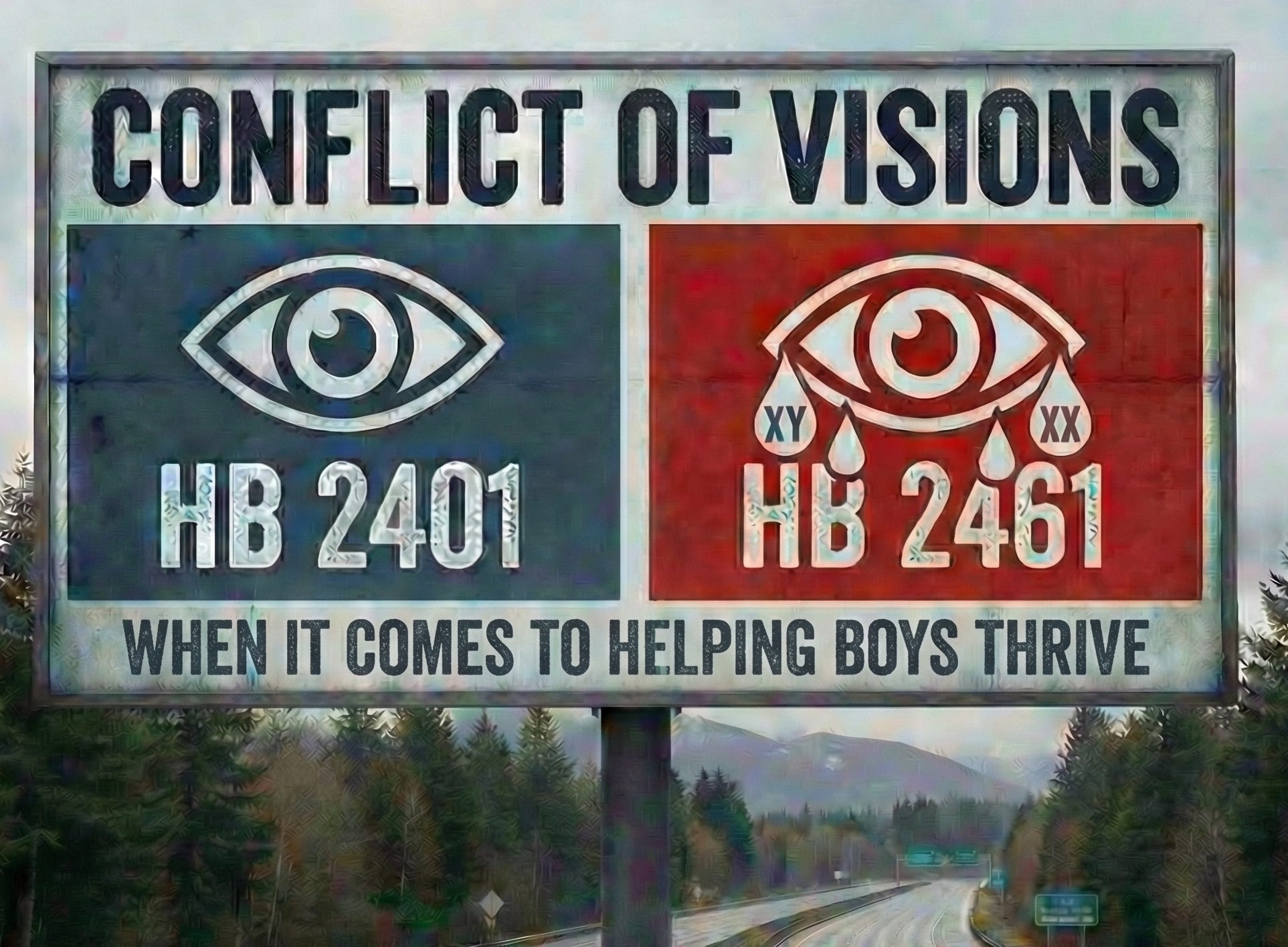
Two House Bills in Washington and the Conflict of Visions
Spending the time to read through two House Bills (HB 2461 and HB 2401) in Washington State, that aim to create a commission on the status of boys and men, reveals the way conflicting visions too often drive us away from root causes. The visions are far apart enough that it seems as though there is no common ground, particularly in places like Washington, where a one-party vision is more likely in a one-party state, so finding middle ground is nearly impossible—or pretending to is more to the point.
It’s important to believe that both sides (left and right) actually care about boys and men, but political and ideological reasons too often get in the way of finding real solutions. In many of these instances, opposing parties share the same statistics, but the interpretations of them and the cause, effect, and solutions are often quite different.
House Bill 2401 relies heavily on words like “loneliness,” “belonging,” and “isolation” as the root cause of these issues and that these concerns will be minimized when boys and men find pathways in education and work. On the surface, it sounds quite good and there is some real hope in that idea.
But nowhere in a bill about boys and men is there a reference to sex-difference, biological sex, and male and female brain-difference. Simply stating biological-sex in HB 2401 would go a long way in acknowledging and addressing what modern science has shown over the last several decades and continues to show.
There are male and female differences that matter when it comes to solutions. HB 2401 wants to “advocate for policies that increase the sense of belonging and decreases isolation and loneliness in boys and men” (HB 2401). But whose sense of belonging are these males aligning with? My concern is that “belonging” will have to align with a vision that denies sex difference and begins with the notion that male is inherently flawed, like the U.K. struggle-sessions mentioned above that will breed a generation of boys connected to ideological visions that align almost entirely with cultural practices at the expense of male and female nature and nurture.
HB 2401 largely ignores the root causes of the real challenges boys face, like fatherlessness. It relies on soft-science instead of looking at the intersection of male and female brain difference, nurture, and culture. HB 2401 offers simple ideas that seem good on the surface but are shallow when it comes to actual solutions.
Many will look at hiring more male teachers, for instance, as a way to solve the boy gender-gap in education. Both the left and right will argue that hiring more male teachers is a good idea. That may well be true in a career sense for men but not necessarily true in improving the educational outcomes of boys and girls. The identities of persons, not the quality of teaching approaches, becomes the underlying mechanism for left-leaning change and right-leaning buy-in.
The blanket statement, more male teachers, is an example of identity politics creeping into policy. In truth, a boy or girl will not learn as well, whether the teacher is male or female, if the teacher’s approach does not recognize that males and females learn differently. This observation is just one area where HB 2401 falls short. Educational data over the last several decades shows, at the very least, a strong correlative.
A study out of Stanford Medicine falls into a long line of studies that should encourage policymakers to look at brain differences more robustly. The Stanford study used artificial intelligence to help identify the deeper neural components that distinguish the difference between male and female brains. In the study, “researchers tested the model on around 1,500 brain scans, [and] it could almost always tell if the scan came from a woman or a man.”
The team at Stanford “wondered if they could create another model that could predict how well participants would do on certain cognitive tasks based on functional brain features that differ between women and men. They developed sex-specific models of cognitive abilities: One model effectively predicted cognitive performance in men but not women, and another in women but not men. The findings indicate that functional brain characteristics varying between sexes have significant behavioral implications” (Stanford Medicine News Center).
Those arguing against male and female brain difference often offer simple solutions that are easy to embrace. Employing different teaching strategies in schools or different counseling approaches in therapy, based on brain-difference, is a much harder concept to get one’s head around—so to speak. Perhaps more men would pursue fields in education and the social sciences if biological differences were integral to its foundations; because in doing so, the nature of male would be seen as necessary and different. The same holds true when it comes to the nature of female. This approach does not limit male and female potential, but it liberates males and females, helping them thrive by exercising their abilities in all sorts of areas of life.
House Bill 2461, conversely, makes a point of mentioning that “many institutional frameworks have not sufficiently accounted for male-specific developmental, biological, and social needs, contributing to persistent disparities affecting boys and men across education, public safety, health, housing, and workforce participation.” The reference to “male-specific development” and “biological” is perhaps the best language that I’ve ever seen in a bill and one I would encourage policy makers to use in bills for women as well, including phrases “female-specific development” and “biological.” That phrasing is critical.
House Bill 2461 sees loneliness as a response exercised differently in males and females. HB 2461 sees, more accurately, that poor education of males, systemic practices against males, and other challenges—such as fatherlessness as root causes. HB 2461 is not afraid to address sex differences (XY and XX) and how government policy works against it. HB 2461 also sees isolation instigated by “systemic, cultural, and institutional factors contributing to these outcomes and [the need] to develop evidence-based policy recommendations to improve outcomes for boys and men.” If we deny that males and females are different, how can males ever feel included and nearly always in the position to acquiesce—to bend the knee as it were?
HB 2461 exposes that there are deeply embedded policies and practices in Washington and across the U.S. that violate equal protections at the least, ignore male and female difference, and portray males as inherently problematic and less deserving. After all, the Washington State Commission on Women, the LGBTQ Commission, and other identity commissions are funded because they fall into an identity-politics mindset. Bill 2401 will not fund the commission but rely solely on donations. This is a big selling point that allows left-leaning policymakers to say we created a commission but that we still see males as privileged. The question is why? It makes sense to acknowledge that mid-terms are right around the corner and males and married women moved to the right in the 2024 election, something that worries democrats.
It’s transparent in today’s political climate that part of the impetus behind HB 2401 is a failed 2024 national election and an upcoming set of midterms that needs male voters. I wonder, if Kamala Harris won, would anyone really take this issue seriously?
The truth is that HB 2401 will likely pass because it does not need bipartisan support, but it may gain some Republican support for fear of seeming uncaring or being unaware of the real consequences of a bill that is afraid to acknowledge male and female difference.
As stated earlier, the right-leaning policymakers, who are well-intentioned, too often do not know how to actualize policies that will help males thrive. The same could be said of some left-leaning policymakers.
There is one policymaker, however, who does understand this issue better than any policymaker in the house or senate, Representative Mary Dye (R). She created the first bill nearly five year ago. Her ideas have been somewhat marginalized by left-leaning policymakers and original supporters who are fearful of a one-party state with a one-party vision. Democrats have the numbers in the house and the senate to simply squash a bill or support a bill that does not fall in line with a left-leaning mindset.
My hope is that we will eventually see competing bills in red states and purple states across the country that are unabashed when it comes to understanding root causes. Sex difference matters when it comes to exercising change, and that cannot happen unless we marry the intersections of nature, nurture, and culture.
See and hear more from Sean Kullman at the Gurian Summer Training Institute this June. To learn more and to register, click https://gurianinstitute.com/events/gurian-summer-institute-2026/. To register groups of five or more and for any questions please contact Dakota Hoyt at info@gurianinstitute.com. We hope to see you in June!
Related News
On September 18, I attended the Virginia Blueprint: Strategies for Boys and Men Conference at the Virginia General …
The Center, A Place of Hope, provides leading edge help for depression and other mental health issues. …

Have you listened to The Wonder of Parenting podcast? We are proud to have been doing this podcast …